
2026-08-27
Gap: River bank turns too sharp
Short stretches of carved river bank turned more than 30 degrees per meter, cutting a notch instead of a curve. A related question about carve grid resolution surfaced meanwhile.
Gap: River bank turns too sharp
The angle limit ran as a clean-up pass after carving, correcting turns the earlier rules got wrong; it moved into the carving step so the bank builds correctly first time. The dial is now a real-world distance in meters, not grid cells, after two incidents where a cell-based dial changed meaning as resolution changed. On a full island rebuild, sharp-turn violations halved against the unfixed baseline.
Gap: Carve grid too coarse for a smooth bank curve
Five sites were tested at four grid sizes: 4 meters, 1 meter, half a meter, and a tenth of a meter. The angle fix removed sharp turns at every size; resolution controlled the shape between them: coarse stair-stepped, fine stayed smooth. A tenth-of-a-meter grid added a new notch-line artifact and raised cost, scaling with the square of resolution. Half a meter was chosen: clean curves at affordable cost.
The fine grid applies only where rivers carve, layered over the coarser base grid and stitched at the seam. A full island build processed 14.45 million fine-resolution cells across 6,541 tiles in just over 17 minutes, with no gaps or cracks across 448,558 vertices. Frame rate in an internal preview dropped to 11-12 frames per second, about a third the coarser rate: the top open item before shipping.
Unresolved: terrain wedges above the water surface
A separate check flagged over fourteen thousand cells where water sat slightly above the ground mesh: the finer carve cut away ground the coarser carve had not, while water stayed keyed to the older ground. The cause was a buffer-width dial defined relative to grid cell size rather than a fixed distance. The wedges were judged a liked visual effect and kept; the check still fails those cells, and moving its threshold remains open.
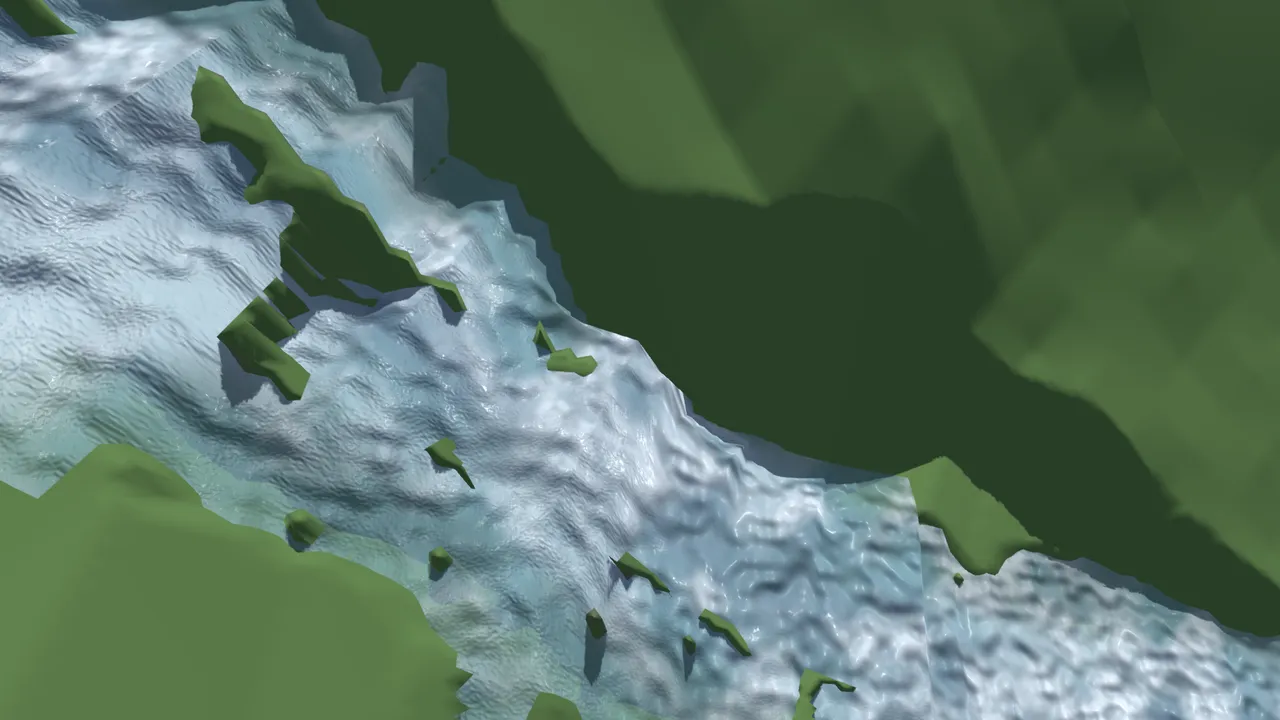 Terrain wedges break the water surface along certain banks — flagged by the
check, kept anyway as a liked visual quirk.
Terrain wedges break the water surface along certain banks — flagged by the
check, kept anyway as a liked visual quirk.