
Error Reports an Agent Can Act On
CI FOR AI-WRITTEN CODE — ERROR REPORTS A HUMAN CAN RULE ON IN MINUTES
0.4 s test loop · 248 tests in ~14 s · 13 real bugs re-injected as mutations · 2026-071 · Background & problem
In this project, AI agents write most of the code. The limiting resource is the human's review time and judgment.
Problem: standard CI reports failures as raw logs, and a passing test suite proves nothing if the tests are incapable of failing.
2 · Gaps & countermeasures
| gap | countermeasure |
|---|---|
| raw logs require manual interpretation | failures arrive as a one-page visual report (A3) |
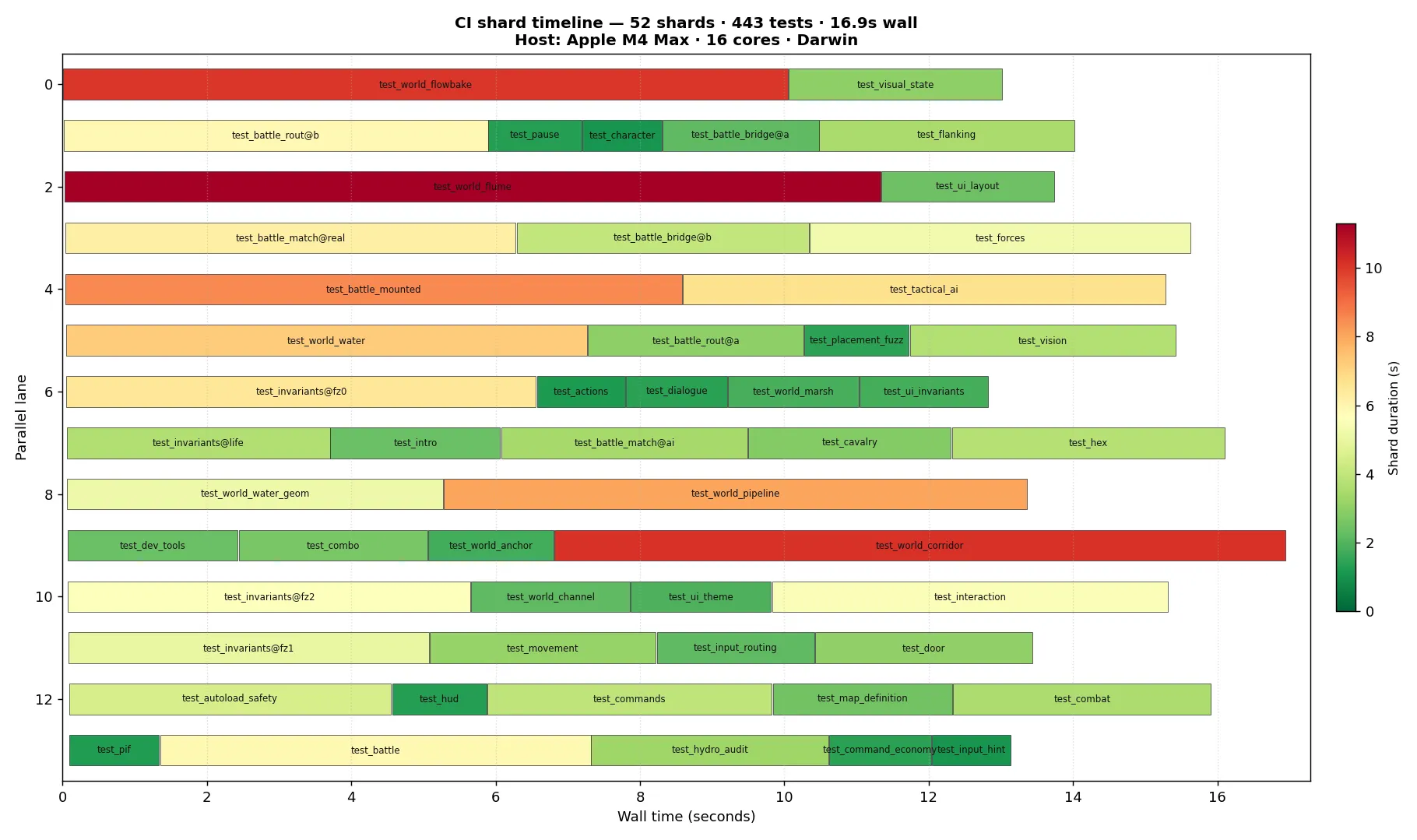
| slow feedback breaks the agent's workflow | a single test runs in 0.4 s; the full suite runs in parallel |
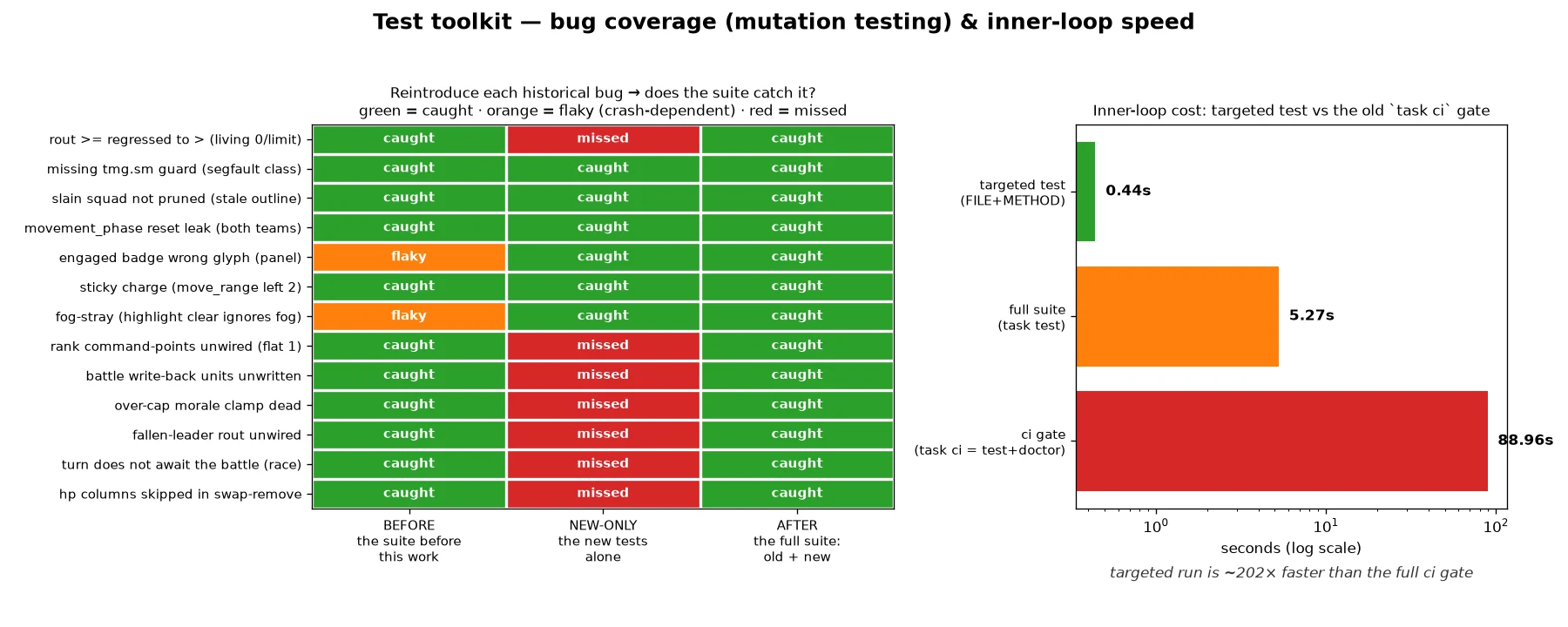
| a passing suite can be meaningless | mutation testing: 13 real bugs re-introduced; the suite must catch every one |
| costly operations fail only after the cost is paid | budget checks run first and refuse over-budget work up front |
BEFORE · failures arrived as raw logs that required manual interpretation · there was no proof the tests could actually detect bugs
AFTER · every failure arrives as a one-page visual report · all 13 re-introduced bugs are provably detected · full suite: ~14 s · single test: 0.4 s
3 · Results — the evidence
mutation #12 · a race condition: s/await attack_phase(team)/attack_phase(team)/ — removing one keyword re-introduces a real shipped bug; the suite must detect it
4A · Resolved: the test suite is proven trustworthy
- A single test runs fast enough (0.4 s) for an AI agent to test after every edit · all 13 historical bugs are demonstrably detected · failures are delivered as decisions, not logs
4B · Unresolved: the bug library grows with the project
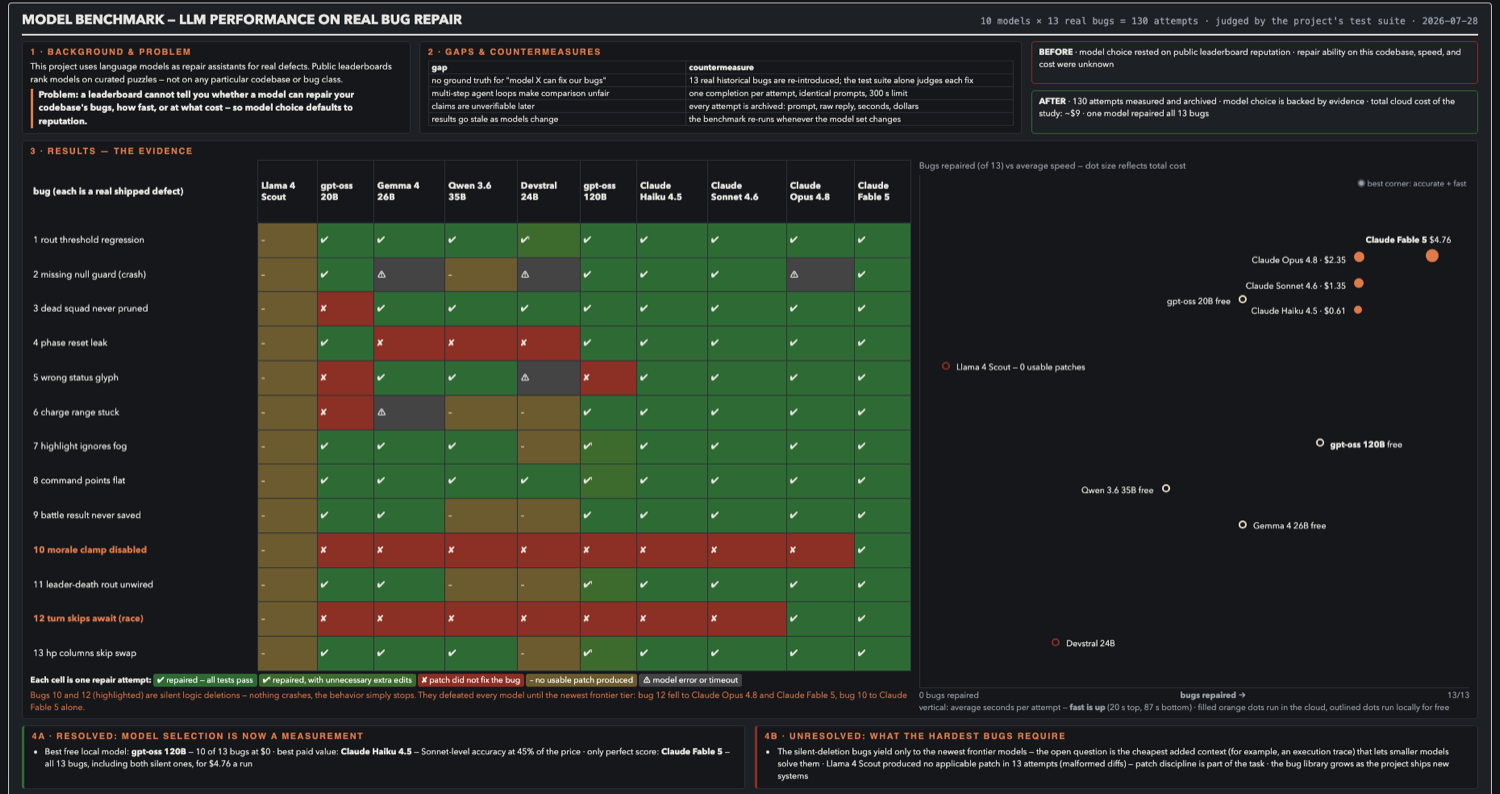
- Each new production bug is added to the mutation library once a test provably detects it · the same bug library also serves as a live LLM benchmark — see the model-benchmark article